

Stuck right nowWinter
Frozen car lock or door in Winnipeg: what to do (and why not hot water)
A frozen car lock is a Winnipeg rite of passage. Here is what actually works at minus thirty, what makes it worse, and how to stop it happening again.
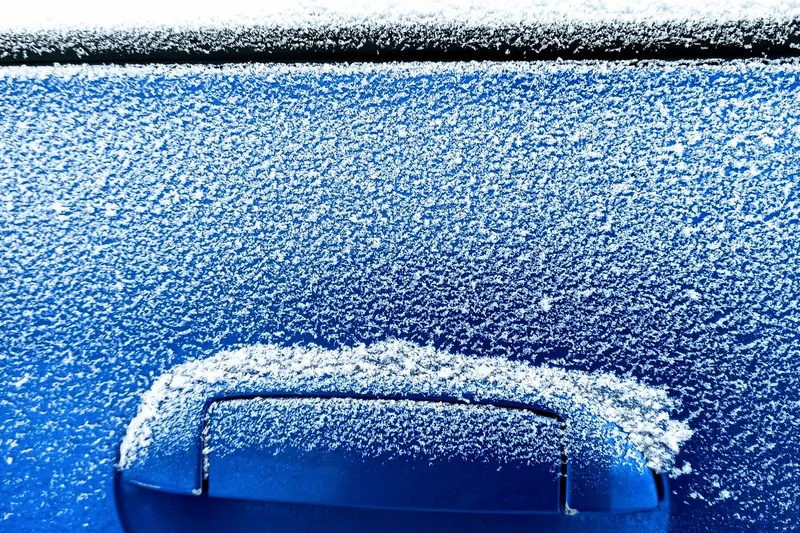
Here is the order that works on a Winnipeg morning when the car has sat all night at minus thirty.
Should I try the other doors and the trunk first?
Yes, every time. Ice doesn't form evenly. The driver's door takes the wind and the slush from the street, while the passenger side or the hatch is often fine. AAA's first piece of advice for a frozen lock is exactly this: if the lock is frozen and the fob isn't helping, try the locks on your other doors (AAA via 6abc).
Once you're in through any door, start the car, let the heater work on the cabin, and the frozen door will often free itself from the inside within a few minutes.
Try every other door and the trunk. Once you're in, start the car and let the heater work.
Does lock de-icer work, and why not hot water?
Lock de-icer works. It is made to melt ice inside the cylinder and it evaporates rather than refreezing. Squirt it into the keyhole, wait a moment, then try the key gently.
Hot water is the classic mistake. AAA is blunt about it: never pour hot or boiling water on your car, because it can shatter the glass. Even when the glass survives, the water runs into the lock, the latch and the seals, and in our cold it refreezes within minutes, usually deeper than the original ice.
The catch with de-icer is where you keep it. CAA's winter kit advice is to keep lock de-icer with you, not in the vehicle, in extreme cold (CAA emergency kit). A can in the glovebox is no help when you can't open the door.
Never pour hot water on the car. It can crack the glass and refreezes deeper. Use lock de-icer.
No de-icer? What else can I use on a frozen car lock?
Hand sanitizer is the best stopgap most people have in a coat pocket. AAA suggests a little hand sanitizer or isopropyl alcohol on the key so it can slide in, then turning it gently. The alcohol lowers the freezing point of the ice it touches.
You can also warm the key itself:
- Hold the metal blade in your gloved hand for a minute, or breathe on it through cupped hands.
- If you warm it any other way, keep the plastic head away from heat. Many keys have a transponder chip or a fob in that head, and melting it creates a second problem.
- Never use a lighter or any flame anywhere near a can of de-icer. Most de-icers contain alcohol and are flammable.
Insert the warmed key, wait a few seconds, and turn with light pressure. Repeat rather than forcing.
A little hand sanitizer on the key, or warm the blade in your hand. Keep any flame away from de-icer.
The lock turns but the door won't open. Now what?
That's the seal or the latch, not the lock. Water has frozen the rubber gasket to the door frame, and pulling hard on the handle can tear the seal or snap the handle.
Try this instead:
- Push firmly inward on the door, all around the edge, to crack the ice bond.
- Pull the handle and hold it out while you push and pull the door gently.
- Get in another door, start the car and let the heat soften the seal from inside.
If the handle itself feels stiff or springy and won't come back, leave it. A broken interior latch rod is much more work than waiting ten minutes for the cabin to warm up.
That's the seal, not the lock. Push in around the edge and don't yank the handle.
Why shouldn't I force a frozen key?
Because a frozen lock is a nuisance, and a key snapped off inside the cylinder is a repair. Brass keys are soft, and a cold key in a frozen cylinder is more likely to twist and break than you'd think. Once half the key is inside the lock, de-icer won't help, and the car now needs the broken piece extracted and possibly a new key cut.
A bent key is a warning sign. If the key has started to twist, stop and switch to de-icer or a call.
This one is a call, not a fix.
Stop turning. A key snapped inside the cylinder needs the piece extracted and possibly a new key cut.
Still can't get in? Car lockout helpHow do I stop my car doors freezing shut in a Winnipeg winter?
A few habits remove most frozen mornings:
| Habit | Why it helps |
|---|---|
| Wipe the door seals dry before parking for the night | No water on the rubber means nothing to freeze the door to the frame |
| Treat the seals before the deep cold | AAA suggests a spray like WD-40 on the inside of the seal, or petroleum jelly if that's what you have |
| Unlock with the fob, not the key | The key cylinder stays sealed and dry, so there's nothing to freeze inside it |
| Park nose out of the wind when you can | The driver's door isn't the one taking the blowing snow all night |
| Keep de-icer in your coat, not the car | You can reach it when the door won't open |
If you rely on the fob, it helps to know what to do when the fob itself gives up in the cold. That has its own guide: key fob not working in cold weather.
A note on remote starters: they are a gift in January, but never leave the only key in a running car, and never remote-start a car parked in a closed garage. Health Canada advises against idling a vehicle in the garage even with the door open, because carbon monoxide builds up and can seep into the house (Health Canada). If a child or pet is locked in a car, call 911 first.
The free printable covers this, so you can tick it off once and keep it.
When should I call a locksmith for a frozen car lock?
Call when you've tried the other doors, the de-icer and a warmed key, and you're about to reach for force. That's the moment a frozen lock becomes a broken one. Call too if:
- the key has bent or snapped in the lock,
- the key is locked inside the car,
- a door has been forced and now won't latch or lock.
A locksmith has tools made to open a car door without prying at it, and can deal with a broken key or a lock that has stopped working. If you're locked out right now, see car lockout help.
If it's the garage door that froze shut instead of the car, the causes and fixes are different: see garage door won't open in cold weather. And if you've lost the key altogether, read can a locksmith make a car key without the original.
This one is a call, not a fix.
That's the moment to call, before force turns a frozen lock into a broken one.
Still can't get in? Car lockout helpQuestions people ask
- Can I use WD-40 on a frozen car lock?
- It is not a de-icer. AAA suggests a spray like WD-40 on the door seals before the cold arrives to help stop doors freezing shut, but for a lock that is already frozen, a proper lock de-icer is the right tool.
- Does hot water work on a frozen car lock?
- No. AAA warns never to pour hot or boiling water on your car. It can crack cold glass, and the water that runs into the lock and seals refreezes, often worse than before.
- How do I keep my car doors from freezing shut?
- Wipe the rubber door seals dry before the car sits overnight, treat them before the deep cold, park nose out of the wind when you can, and use the fob to unlock so the key cylinder rarely has to turn.
Still stuck? Call, and a person answers.
Open 24 hours, 7 days. Tell us which one it sounds like, or text a photo first.
Still can't get in? Car lockout help · You approve the price before we start.
Keep reading
All guides Right now
Garage door won't open in the cold? Five Winnipeg winter causes
Deep cold stops garage doors in five predictable ways. Here is how to tell which one you have, and which ones to leave alone.
 Plan ahead
How to winterize a garage door before a Winnipeg winter
An hour in October saves a stuck door in January. Here is the whole routine, in order, and what to leave to a technician.
 Plan ahead
Keys or fobs? Choosing access control for a small business
Cards, fobs and codes can be switched off the moment someone leaves, and they record who opened which door. Here's what a small business system involves and where to start.