

Stuck right nowLockouts
Keypad or smart lock battery dead? How to get back in
A dead keypad deadbolt usually has a way back in: a key cylinder, two 9-volt contacts or a USB port. Here's how to find yours before you're standing on the step at minus 30.
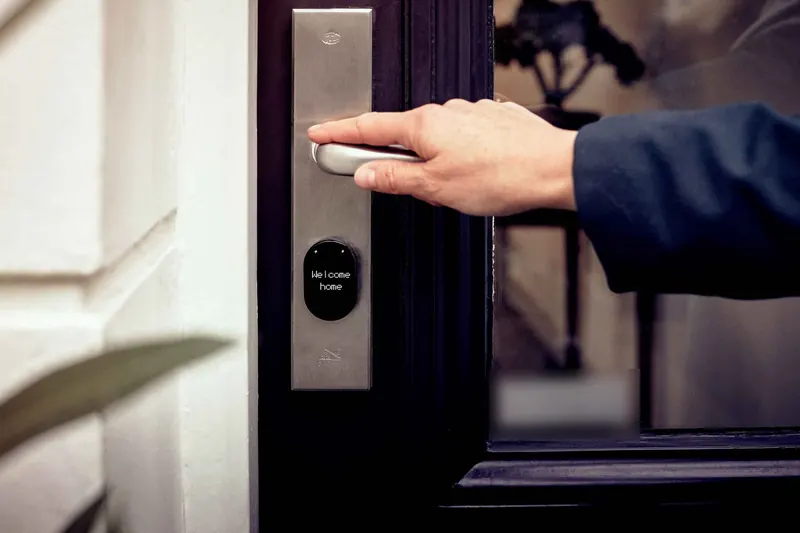
Here's how to tell which backup you have, what the big brands use, and why a Winnipeg winter is hard on these locks.
Which backup does my keypad lock have?
Look at the outside half of the lock, the part with the keypad, in good light. You're looking for one of three things.
- A key cylinder. A normal keyhole, either in plain sight below the keypad or under a small cap or slide. If you have the key, this is the simplest way in, and it works with no power at all.
- Two metal contacts. Two small studs or pads, usually at the bottom of the keypad. You hold the two terminals of a fresh 9-volt battery against them, and the lock wakes up long enough for you to enter your code.
- A USB port. Some newer smart locks have a USB-C or micro-USB port on the outside. A phone power bank and cable give the lock enough power to take your code.
If you can't see any of these, check your manual or the maker's support page. Find the model number on the inside half of the lock or on the box, and search it. Do this now, while the door is open, rather than on the step.
Look on the outside half of the lock for a key cylinder, two metal contacts or a USB port.
What do Schlage, Kwikset and Yale use?
Each brand and model is a little different, so treat this as a starting point and confirm with your own manual.
| Brand and model family | Backup when the battery dies | Source |
|---|---|---|
| Schlage Touch deadbolt and lever (BE375, FE695) | A 9-volt "battery jump" on the contacts below the keypad, then enter a code | Allegion support |
| Schlage keypad deadbolt | Runs on a 9-volt battery inside the lock; a continuous blinking red Schlage button means the battery is low | Schlage tip sheet (PDF) |
| Kwikset keyless deadbolts with terminals | A 9-volt held on the terminals; if nothing happens, flip the battery or try a new one | Kwikset support |
| Nest x Yale Lock | A standard alkaline 9-volt held on the contacts at the bottom of the lock, then your passcode | Google support |
A few things the makers agree on:
- Use a fresh alkaline 9-volt, the square kind. A half-dead one from the junk drawer may not wake the lock.
- Keep it touching both contacts the whole time you enter the code. If you pull it away early, start again.
- Change the batteries the moment you're inside. The 9-volt only powers the lock for that one opening. Schlage warns that on some models the door can stay unlocked from the outside until you replace the batteries or relock it by hand.
What if my lock has no visible backup?
Some keyless models have no key cylinder at all and rely on the contacts or a USB port. If your lock has neither, or the backup doesn't wake it, the lock may have a fault rather than a flat battery. That's the point to stop experimenting.
Use a fresh alkaline 9-volt, flip it, and keep it on both contacts while you enter the code. If it still won't wake, stop experimenting.
Why does cold weather drain smart lock batteries faster?
Batteries deliver less power when they're cold, and a front door in a Winnipeg January spends weeks well below freezing. A lock that worked fine in October can start struggling when the motor has to throw a stiff, cold bolt on a set of batteries that are already part-used.
That's why the warnings matter. Most locks tell you before they quit:
- a flashing red light or a beep pattern after you enter a code
- a low-battery alert in the app, if the lock is connected
- a slower, weaker sound from the motor as it turns the bolt
It's easy to dismiss these for a week. In winter, that week is often the one where the lock gives up, usually when you're coming home late with groceries and no key on your ring.
Frost and drifting snow cause trouble too. If the keypad is iced over or the bolt is binding because the door has shifted in the cold, the lock can work harder and drain faster. If your bolt drags, that's worth fixing on its own. There's more on how electronic locks cope with our winters in our guide to the best smart lock for Canadian winters.
Change the batteries now. In winter, that week of warnings is often the week the lock gives up.
How do I stop this happening again?
A battery routine takes two minutes and saves a cold night.
- Change the batteries on a fixed date, not only when the lock complains. Schlage suggests doing it when you test your smoke alarms each year. Before the first deep freeze is a good second date for Winnipeg.
- Use the battery type the maker names. Some makers specify alkaline; check before switching to lithium or rechargeables.
- Keep a fresh 9-volt somewhere you can reach from outside: in the car, your bag or the garage, not inside the house.
- Keep a mechanical key if your lock has a cylinder, and keep it off-site or with someone you trust.
- Share the code with one person nearby, so you have a second way in if you're away and something fails.
Change the batteries on a fixed date, and keep a fresh 9-volt somewhere you can reach from outside.
What happens if there's no backup and no key?
Call a locksmith. A keypad deadbolt is still a deadbolt underneath, and an experienced locksmith opens most of them without damage, by picking the key cylinder where there is one or by other non-destructive methods. Drilling is the last resort, kept for a lock that has failed or is built to resist picking, and you should be told why before anyone starts. If you want to know what that looks like, read does a locksmith break your lock.
When we come out, our technician asks for your ID before opening the door. If it's inside, we check it once the door is open. Why a locksmith asks for ID explains how it works.
If you're standing outside a dead keypad lock right now with no backup, locked out of your house is the page you need. Once the door is open, we can also look at why the batteries died early: a binding bolt or a cold-stiff door is a common cause, and an easy one to fix while we're there.
This one is a call, not a fix.
Call rather than forcing the lock. Most keypad deadbolts open without damage, and drilling is the last resort.
Locked out of your houseThe short version
- Find your lock's backup now: key cylinder, 9-volt contacts or USB.
- Keep a fresh alkaline 9-volt outside the house.
- Treat every low-battery warning as urgent between November and March.
- No backup, no key: call for help rather than forcing the lock.
Questions people ask
- How do you open a keypad lock with a dead battery?
- Use the backup your model has. On many locks you hold a fresh 9-volt battery against two contacts on the outside of the lock while you enter your code; on others you use the key in the hidden cylinder or plug a power bank into a USB port. Then replace the batteries right away.
- Do keypad locks have a key backup?
- Many do. A lot of keypad deadbolts have a regular key cylinder, sometimes hidden under a cover. Some keyless models skip it and rely on 9-volt contacts or a USB port instead, so check your manual.
- How often should I change smart lock batteries?
- Change them as soon as the lock warns you, and on a fixed schedule even if it doesn't. Schlage suggests replacing batteries at the same time each year that you test your smoke alarms. In a Winnipeg winter, do it before the deep cold arrives.
Still stuck? Call, and a person answers.
Open 24 hours, 7 days. Tell us which one it sounds like, or text a photo first.
Locked out of your house · You approve the price before we start.
Keep reading
All guides Right now
Does a locksmith break your lock to get you in?
Most house locks open without damage. Here's when drilling is genuinely needed, why reaching for the drill first is a warning sign, and what to ask before work starts.
 Right now
Why a real locksmith asks for ID before opening your door
A careful locksmith asks for ID before opening a home or car. Here's what to have ready, what happens when your ID is inside, and why being asked is a good sign.
 Plan ahead
Keys or fobs? Choosing access control for a small business
Cards, fobs and codes can be switched off the moment someone leaves, and they record who opened which door. Here's what a small business system involves and where to start.