

How to secure your front door from break-ins
Front doors are usually beaten at the frame, not the lock. Here is where to spend your effort, in the order that makes the biggest difference.
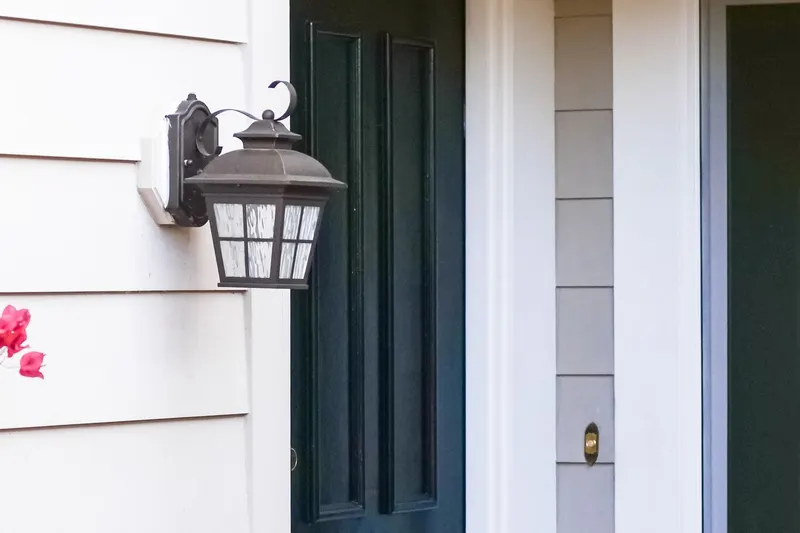
Here's where to spend your effort, in order.
Why do doors fail at the frame, not the lock?
Picture your front door from the side. The deadbolt slides out of the door into a hole in the door frame, called the jamb. On many houses that jamb is a strip of softwood, and the small metal strike plate around the hole is held by two short screws that go into that thin strip and nothing else.
When someone kicks the door, the lock doesn't break. The bolt stays out, but the strip of wood around it splits away from the wall. The door swings open with the bolt still sticking out.
That's why a new lock alone on a weak frame doesn't help much. The fix is to tie the strike into the house's framing.
How do strike plates and long screws stop a kick?
This is the single most useful upgrade for most front doors:
- Fit a heavy-duty strike plate. It's longer and thicker than a standard one, and spreads the force of a kick over more of the frame.
- Use long screws. Screws long enough to pass through the jamb and the gap behind it and into the stud. That turns the strike from "screwed to trim" into "screwed to the house".
- Do the hinge side too. Swap at least one short screw in each hinge for a long one into the framing. A door can fail on the hinge side as well.
- Check the gap. If the door has a big gap at the latch side, the bolt may only just reach the strike. A door that's sagged needs adjusting so the bolt lands centred.
On older Winnipeg homes, frames have often moved over the years with the soil and the seasons. If you have to lift or push the door to turn the deadbolt, the bolt isn't seating properly, and that's worth fixing for security as much as for convenience.
Call or text and a person answers, 24 hours, 7 days. You approve the price before we start.
What makes a good deadbolt, and what does "grade" mean?
A good deadbolt:
- Throws fully. The bolt should extend its full length into the frame, typically about an inch. If the hole in the frame is too shallow, the bolt stops short and can be pushed back.
- Is a deadbolt, not just a latch. The spring latch in your handle can sometimes be slipped. A deadbolt can't be pushed back without the key or the thumbturn.
- Has a graded rating. Many locks are tested to ANSI/BHMA standards and given a grade from 1 to 3, with Grade 1 the heaviest duty (Allegion, understanding ANSI grades). The grade is printed on the box or the spec sheet.
A double cylinder deadbolt (a key on both sides) is sometimes suggested for doors with glass, but it can slow you down getting out in a fire. If you have one, keep the key near the door where everyone in the house knows where it is, and check any rules that apply to your home before choosing one.
What should you do about glass beside the door?
Sidelights and glass panels in the door are a weak point if someone can break the glass and reach the thumbturn.
- Check the reach. If an arm through the nearest pane can reach the deadbolt, the glass is part of your security.
- Security film on the inside makes the glass harder to break through quickly.
- Decorative grilles inside the glass can block the reach.
- Don't leave keys hanging by the door where they can be seen or reached through the glass.
Do lights, sightlines and habits really matter?
They matter as much as hardware. The Winnipeg Police Service's advice for garages and sheds applies to the front door too: lock every way in and check it, add motion-activated lights, and consider a camera that can discourage thieves and help identify them (WPS news release).
Simple habits make a difference:
- Lock the door when you're home, especially the back door while you're in the front yard, and vice versa.
- Trim shrubs so the entrance is visible from the street.
- Light the entrance and the path, and use a timer when you're away.
- No spare under the mat, in the planter or on top of the door frame. Those are the first places anyone checks.
- Keep a parcel from sitting on the step for days while you're away. Ask a neighbour.
Are smart and keypad locks more or less secure?
A smart deadbolt is as strong as its bolt and its strike, just like any other deadbolt. What changes is convenience, and what you have to manage: batteries, codes and app access. In a Winnipeg winter there's also the question of how the electronics handle the cold. Our guide to smart locks in a Winnipeg winter compares published temperature ratings.
If you're changing locks anyway, ask about having them keyed alike so one key opens every outside door. Our guide on rekey or replace your locks explains when new hardware is the better choice.
What if the door has already been forced?
Then the order is safety, report, photograph, insurer, secure. Our guide on what to do after a break-in covers the first 24 hours.
Where do you start?
Walk to your front door and check three things: how long the strike plate screws are, how far the deadbolt throws, and whether you can reach the thumbturn through any glass. If any of them fails, it's worth fixing before winter, when nobody wants to be standing in the cold with the door open. We fit new deadbolts, heavy-duty strike plates and long screws as one job. See lock change and new deadbolts.
The printable move-in lock checklist below covers every outside door in one walk-through.
Questions people ask
- What is the best way to reinforce a front door?
- Start with the strike side of the frame: a heavy strike plate fixed with long screws that reach the stud behind the jamb. Then make sure the deadbolt throws its full length, and replace the short hinge screws with long ones too. Those three changes do more than a new lock on a weak frame.
- Does a deadbolt stop a door being kicked in?
- A deadbolt only holds as well as the wood it locks into. On a standard door, the bolt sits in a thin jamb held by short screws, and a kick splits the jamb. A deadbolt with a full throw into a reinforced strike plate and long screws is much harder to kick through.
- Are smart locks less secure?
- Not by default. A smart deadbolt still relies on the same bolt and the same frame, so the strike plate and screws matter just as much. The differences are batteries, codes and app accounts, which you need to manage, and how the lock copes with cold.
Ready to sort it? Call or text.
Open 24 hours, 7 days. Text a photo first if that is easier.
Lock change and new deadbolts · You approve the price before we start.
Keep reading
All guides Right now
What to do after a break-in: the first 24 hours
A break-in turns an ordinary day upside down. Here is the order to do things in, from the first phone call to a door that locks properly tonight.
 Right now
Lost your house keys? Whether to change the locks, and what's quicker
Lost your keys and wondering if you need new locks? One question decides it, and rekeying usually means you keep the locks you have.
 Right now
Safe won't open? Dead battery, lost code or a lock fault
Most safes that won't open have a tired battery, not a broken lock. Here's the order to check things in, how a lost combination is recovered, and when to call a safe technician.