

Commercial door lock types: a plain guide for business owners
Most business doors use one of four lock types. Here's how to tell them apart, which suits which door, and what BHMA grades and interchangeable cores mean.

Here's how to tell them apart when you're standing at your own front door, plus the parts that matter most: cylinders, grades and Winnipeg winters.
The four types at a glance
| Lock type | Where you'll see it | How to recognize it |
|---|---|---|
| Cylindrical lever lock | Offices, back-of-house doors, washrooms | A lever on each side and a round chassis through the door |
| Mortise lock | Busy entrances, schools, older buildings | A tall rectangular plate on the door edge; often a lever and a separate key cylinder |
| Storefront (narrow-stile) deadbolt | Aluminum and glass shop doors | A key cylinder in a narrow aluminum frame, often with a thumbturn inside |
| Exit device (panic bar) | Required exits, assembly spaces, rear doors | A bar or touchpad across the inside of the door |
What is a cylindrical lever lock?
A cylindrical lock fits through two round holes drilled in the door: a large one through the face and a smaller one into the edge for the latch. The lever, the latch and the key cylinder are all part of one assembly, which makes it quick to install and replace.
They're common on interior offices, staff rooms and secondary exterior doors in strip malls and light industrial units. Lever handles are the norm on commercial doors because they're easier to use with full hands, gloves or limited grip.
The relevant standard is ANSI/BHMA A156.2, which covers bored and preassembled locks and latches (ANSI).
Call or text and a person answers, 24 hours, 7 days. You approve the price before we start.
What is a mortise lock?
A mortise lock sits in a deep rectangular pocket, the mortise, cut into the edge of the door. The lock body is larger and heavier than a cylindrical lock, and many combine a latch and a deadbolt in one unit. You'll know one by the tall faceplate on the door edge.
Mortise locks are built for doors that open hundreds of times a day: the main entrance of an office building, a school, a clinic, or an older building in the Exchange District where the original doors have been kept. They're covered by ANSI/BHMA A156.13, mortise locks and latches (ANSI).
What lock goes on a glass storefront door?
Aluminum and glass storefront doors have a narrow frame around the glass, called the stile. There isn't room for an ordinary deadbolt, so these doors use a narrow-backset mortise deadlock, usually with a key cylinder outside and a thumbturn or second cylinder inside.
Many storefront deadlocks use a hook-shaped or pivoting bolt that swings into the frame, which makes it harder to pry the door away from the latch. Storefront doors are also where you often see a panic bar, or an access-control reader on a strike in the frame.
A word on double-cylinder locks, the kind that need a key on both sides: Allegion notes they shouldn't be used on any door that is required for egress (Allegion). If your shop door has a key cylinder inside, check whether it's a required exit before relying on it.
What are exit devices and panic bars?
An exit device is a bar or touchpad across the inside of the door. Push it and the door unlatches, without a key, a turn or any knowledge of how the lock works. That's the point: in an emergency, anyone can get out.
Exit devices are covered by ANSI/BHMA A156.3 (ANSI). On the outside, they may have no hardware at all, a pull handle, or a lever or key cylinder for entry.
Egress comes first. Whether a door needs panic hardware depends on the building, its use and the codes that apply to it, so don't remove or replace an exit device without checking.
Outside trim: lever or rim cylinder
The hardware on the outside of a panic bar door is called the trim. The two common choices for keyed entry are:
- Lever trim. A lever on the outside, locked or unlocked with a key, so staff can come in the same way they go out.
- Rim cylinder. A key cylinder on the outside that retracts the latch when you turn the key. It suits rear and service doors where only a few people need to get in.
A door with no outside hardware is exit only. Adding trim later is often possible on the same device, as long as the trim matches the make and model of the bar.
When a panic bar needs repair
The usual signs are a bar that sticks or needs a hard push, a latch that doesn't catch when the door closes, a door that won't stay locked, or a dogging function that no longer holds the bar down. A worn exit device on a busy door usually tells you before it fails, so it pays to act on the first sign. We repair and install panic bars, including lever trim and rim cylinder outside trim: see our commercial locksmith page.
What are interchangeable cores and restricted keys?
The cylinder is the part your key goes into, and on commercial doors it's where most of the security and convenience lives.
- Interchangeable cores (IC). The keyed core can be removed with a special control key and swapped for another in seconds. When an employee leaves without returning a key, you change the core instead of rekeying the whole lock.
- Restricted keys. The key blank is controlled, so copies can't be cut at any hardware store. Only authorized people can order more.
- Master keying. Each tenant or department has a key for their own doors, while a manager's key opens several and a master opens all. It works with cylindrical, mortise and storefront locks alike.
For businesses deciding between more keys and switching to cards or fobs, our guide to choosing an access control system for small business compares the two.
What do BHMA grades mean?
BHMA grades most lock standards in three levels, with Grade 1 the highest performance, followed by Grades 2 and 3 (ANSI blog). The grade reflects how the lock performs in standardized tests for things like cycles, strength and security.
As a rule of thumb, busy commercial doors call for Grade 1 hardware, and lighter-use interior doors may suit Grade 2. A Grade 3 residential lock on a busy shop's back door tends to wear out fast.
What does winter do to commercial doors?
Winnipeg's cold is hard on commercial door hardware, and the lock often takes the blame for problems that start elsewhere.
- Door closers slow down in the cold, so the door doesn't fully latch. A door that looks closed but isn't latched isn't locked.
- Frost heave shifts frames, so the bolt no longer lines up with the strike and binds or misses.
- Frost and ice build up on outside cylinders and strikes, especially on north-facing doors and back doors by the loading area.
- Salt and grit carried in on boots get into thresholds and the bottom of exit devices.
A fall check of every exterior door, closer and strike prevents most January callouts. Residential owners will find the same ideas, for the house, in how to secure front door from break ins. Landlords with mixed portfolios may want the key log habits from change locks after tenant moves out too.
If you'd like help choosing, rekeying, repairing a panic bar or setting up a master key system for your doors, see our commercial locksmith page.
The short version
- Cylindrical levers suit offices and lighter doors.
- Mortise locks suit busy main entrances.
- Narrow aluminum and glass doors take storefront deadlocks.
- Exit devices let anyone get out; egress comes first. Lever trim or a rim cylinder adds keyed entry from outside.
- Interchangeable cores and restricted keys make staff changes easier.
Questions people ask
- What's the difference between a mortise and a cylindrical lock?
- A cylindrical lock fits through two round holes drilled in the door, and the latch and lever are one assembly. A mortise lock sits in a deep pocket cut into the edge of the door, with a heavier body that often combines a latch and a deadbolt. Mortise locks are common on busy, heavy commercial doors.
- What lock is best for a glass storefront door?
- Aluminum and glass storefront doors usually have a narrow frame, or stile, so they take a narrow-backset mortise deadlock, often with a hook-shaped bolt that resists being pried. Many also have a panic bar or are paired with an access-control reader.
- Can commercial locks be rekeyed?
- Yes. Most commercial cylinders can be rekeyed, and many buildings use interchangeable cores, which let a locksmith swap the core in seconds with a control key. Commercial locks can also be set up on a master key system.
- Can a panic bar have a key on the outside?
- Yes. An exit device can take outside trim: a lever trim that locks and unlocks with a key, or a rim cylinder that retracts the latch when the key turns. Without trim, the door is exit only from the inside.
Ready to sort it? Call or text.
Open 24 hours, 7 days. Text a photo first if that is easier.
Commercial locksmith · You approve the price before we start.
Keep reading
All guides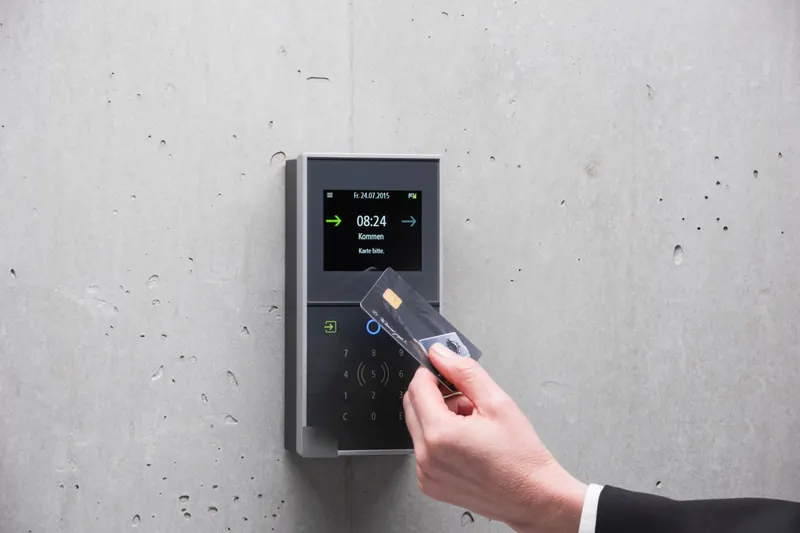 Plan ahead
Keys or fobs? Choosing access control for a small business
Cards, fobs and codes can be switched off the moment someone leaves, and they record who opened which door. Here's what a small business system involves and where to start.
 Right now
What to do after a break-in: the first 24 hours
A break-in turns an ordinary day upside down. Here is the order to do things in, from the first phone call to a door that locks properly tonight.
 Plan ahead
The best garage door for a Winnipeg winter: insulation, R-value and seals
Shopping for a garage door that copes with a prairie winter? Here is what actually keeps the cold out, how to read R-value and U-factor, and when an old door is done.